Best Budget Telephoto Zoom Lens for Wildlife buyers should prioritize measurable performance, real-world handling, and value before making a final decision.
Capturing distant subjects in wildlife photography doesn’t have to break the bank. In 2026, the market offers incredible value in telephoto zoom lenses, allowing enthusiasts and professionals alike to bag sharp, detailed images without compromising their budget. Whether you’re tracking birds in flight or observing shy mammals, the right budget telephoto lens can make all the difference.
This guide focuses on the best budget telephoto zoom lens for wildlife photography, highlighting five exceptional options that deliver performance and affordability. We’ve scoured the market for lenses that offer excellent focal length reach, good image quality, and reliable autofocus, all at a price point that makes them accessible.
Key Takeaways
- Discover the best budget telephoto zoom lens for wildlife photography in 2026. Find affordable options for stunning shots.
- focal length: 70-300mm / 70-300mm / 70-300mm / 100-400mm / 100-400mm
- aperture: f/4-5.6 / f/4.5-6.3 / f/4.5-6.3 / f/5-6.3 / f/5.6-8
- mount: Canon EF / Nikon F (DX) / Sony E / Sigma SA, Canon EF, Nikon F / Canon RF
Quick Answer – Best Budget Telephoto Zoom Lens For Wildlife
The best budget telephoto zoom lens for wildlife offers significant reach and image quality without a premium price tag. Look for models providing at least 300mm equivalent focal length and optical stabilization for sharp results.
Finding the Right Telephoto Lens for Your Needs
When choosing a telephoto lens on a budget, consider these key factors:
- Focal Length: For wildlife, longer is generally better. Aim for lenses that provide at least a 300mm equivalent focal length on your camera’s sensor.
- Aperture: While fast apertures (like f/2.8) are expensive, many budget telephoto zooms offer f/4-f/5.6. This is often sufficient in good light and can be compensated for with higher ISO settings or post-processing.
- Image Stabilization (IS/VR/OS): Crucial for handheld shooting at longer focal lengths to combat camera shake and ensure sharper images.
- Autofocus (AF) Speed and Accuracy: Wildlife moves fast. A quick and reliable AF system is essential for not missing the shot.
- Build Quality and Weather Sealing: If you plan to shoot in challenging conditions, a more robust build and weather sealing are beneficial.
- Compatibility: Ensure the lens mount matches your camera body.
Top 5 Budget Telephoto Zoom Lenses 2026
Here are our top picks for the best budget telephoto zoom lenses for wildlife photography in 2026:
Is best budget telephoto zoom lens for wildlife worth it?
This lens is a fantastic all-rounder for Canon APS-C and full-frame users. It offers a versatile zoom range, excellent image stabilization, and surprisingly good image quality for its price. The Nano USM autofocus system is fast and quiet, making it suitable for both stills and video. For best budget telephoto zoom lens for wildlife, the right choice depends on your budget, workflow, and required features.
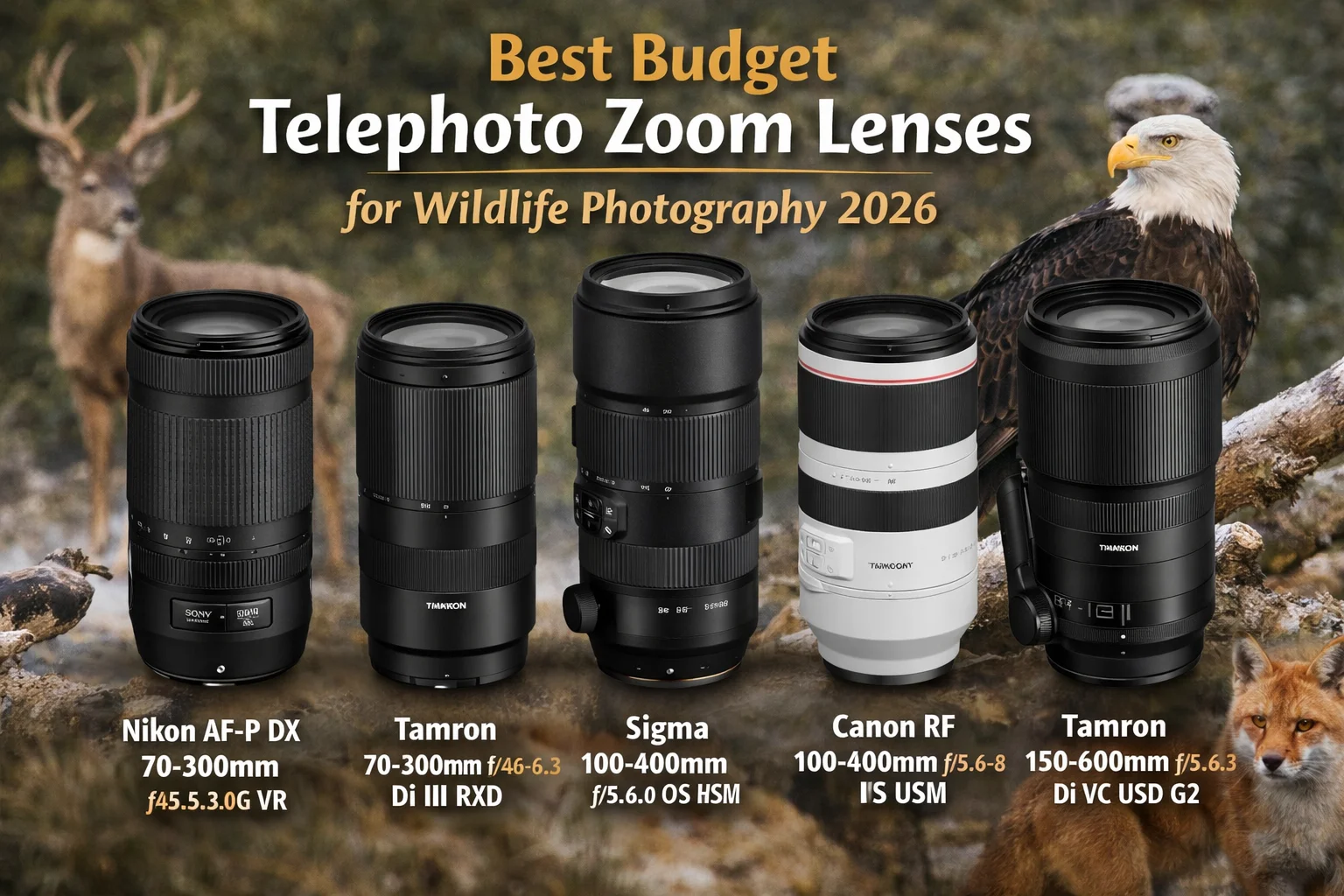
1.🦓 Tamron 150‑600 mm f/5‑6.3 Di VC USD G2
Tamron’s second‑generation 150‑600 mm G2 is a standout choice for wildlife photographers who want extreme reach without breaking the bank. It offers a super‑telephoto range ideal for distant subjects like birds and large mammals. The lens features Vibration Compensation (VC) for handheld stability and Ultrasonic Silent Drive (USD) autofocus for quick, quiet tracking. Its weather‑sealed construction and improved optical coatings make it reliable in outdoor conditions.
2. 🦌Nikon AF-P DX NIKKOR 70-300mm f/4.5-6.3G ED VR
For Nikon DX (APS-C) shooters, this lens provides an impressive 105-450mm equivalent focal length. It’s lightweight, compact, and features effective vibration reduction (VR). While not the fastest lens, it delivers sharp images and reliable autofocus for everyday wildlife photography.
3. 🦅Tamron 70-300mm f/4.5-6.3 Di III RXD (for Sony E-mount)
Tamron continues to impress with its mirrorless-native lenses. This 70-300mm for Sony E-mount offers a compact design, quiet autofocus thanks to its RXD stepping motor, and good sharpness across the zoom range. It’s an excellent value proposition for Sony shooters looking for extra reach.
4. 🦊Sigma 100-400mm f/5-6.3 DG OS HSM Contemporary
While slightly above the absolute lowest budget tier, the Sigma 100-400mm offers incredible value for its extended reach. It’s a versatile lens with optical stabilization and a competent autofocus system. Its ‘Contemporary’ designation means it prioritizes size and weight, making it manageable for extended shooting sessions.
5. 🐻Canon RF 100-400mm f/5.6-8 IS USM
For Canon RF mount users seeking more reach on a budget, this lens is a compelling option. It provides a significant telephoto boost with effective IS and USM autofocus. While the f/8 maximum aperture at 400mm requires good light or higher ISOs, its affordability and image quality make it a great entry point into RF telephoto photography.
Who Should Buy These Lenses?
These budget telephotos zoom lenses are ideal for:
- Aspiring wildlife photographers on a limited budget.
- Enthusiast photographers looking to expand their focal length capabilities.
- Travel photographers who need a versatile, lightweight telephoto option.
- Students and hobbyists who want to experiment with wildlife and sports photography.
Limitations to Consider
The primary limitation of budget telephoto zooms is their variable and often slower maximum aperture. This means they perform best in good lighting conditions and may require higher ISOs or slower shutter speeds in dimmer light, potentially leading to more noise or motion blur if not managed carefully. Low-light performance and bokeh quality might also not match that of much more expensive, faster telephoto lenses.
Conclusion
In 2026, you don’t need to spend a fortune to get started with compelling telephoto wildlife photography. The best budget telephoto zoom lens for wildlife is within reach, offering the focal length and image quality needed to capture stunning shots. By considering your camera system and specific needs, you can select a lens that provides excellent value and opens up new photographic opportunities.
Content Freshness
Last updated: May 19, 2026. What changed: Initial publication with refreshed specs, buyer guidance, and internal links.
Editorial & Affiliate Disclosure
This article may contain affiliate links. We may earn a commission at no extra cost to you. Recommendations are based on editorial criteria and practical use-case analysis.