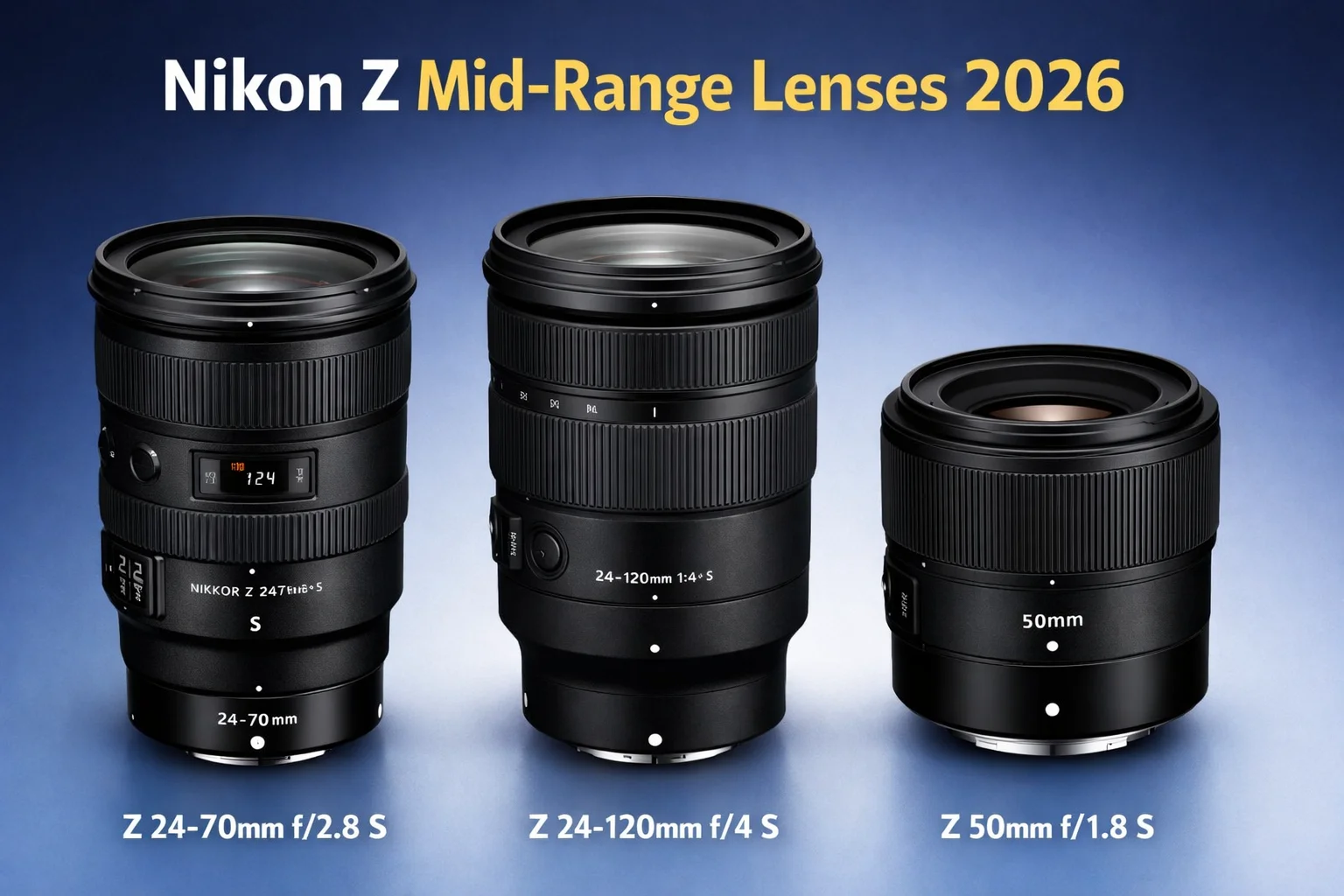
Best Nikon Z Mid-range Lenses 2026 buyers should prioritize measurable performance, real-world handling, and value before making a final decision.
Key Takeaways
- The Nikkor Z 24-70mm f/4 S is the top mid-range zoom for enthusiasts, offering great sharpness and versatility.
- The Nikkor Z 50mm f/1.8 S provides exceptional value with its fast aperture and beautiful bokeh for portraits and low light.
- The Nikkor Z 85mm f/1.8 S is an iconic prime lens, delivering stunning portrait quality and sharpness.
- Enthusiasts should prioritize image quality, versatility, build quality, autofocus, and value when choosing a lens.
Frequently Asked Questions
What is the best all-around mid-range zoom lens for Nikon Z enthusiasts in 2026?
The Nikkor Z 24-70mm f/4 S is considered the best all-around mid-range zoom for enthusiasts. It provides a versatile focal range, excellent sharpness across the frame, and a durable, weather-sealed build, making it suitable for a wide array of photographic needs.
Which Nikon Z prime lens offers the best value for portraits and low light?
For portraits and low-light shooting, the Nikon NIKKOR Z 50mm f/1.8 S offers outstanding value. Its f/1.8 aperture delivers beautiful subject separation and bokeh, coupled with impressive sharpness, making it a favorite for enthusiasts seeking prime lens quality at a mid-range price.
Is the NIKKOR Z 85mm f/1.8 S a good choice for portrait photography?
Yes, the NIKKOR Z 85mm f/1.8 S is an exceptional choice for portrait enthusiasts. It offers iconic focal length performance with remarkable sharpness and a pleasing bokeh that effectively isolates subjects, rivaling more expensive professional options.
As 2026 dawns, Nikon’s Z-mount mirrorless system continues to mature, offering a compelling range of lenses for photographers of all levels. For the enthusiast who balances image quality, versatility, and value, the mid-range segment is where the magic often happens. These lenses provide significant upgrades over kit options without demanding the premium investment of professional-grade glass. Whether you’re upgrading from your first Z camera or expanding your creative toolkit, choosing the right mid-range lens can dramatically elevate your photography.
This guide dives into the best Nikon Z mid-range lenses 2026 has available, focusing on options that offer exceptional performance for enthusiasts. We’ll break down key features, compare performance, and help you decide which lens best suits your shooting style and budget.
Key Takeaways
- Discover the best Nikon Z mid-range lenses 2026 has to offer for enthusiasts. Find top picks and comparisons for your creative needs.
- focal length: 24-70mm (Zoom), 50mm & 85mm (Primes)
- aperture: f/4 (Zoom), f/1.8 (Primes)
- mount: Nikon Z
Quick Answer – Best Nikon Z Mid-range Lenses 2026
The NIKKOR Z 24-70mm f/4 S is the top mid-range zoom for enthusiasts in 2026. It offers a stellar balance of sharpness, versatility, and build quality, making it a superb all-around performer for most subjects, though its f/4 aperture limits extreme low-light shooting compared to f/2.8 primes.
Key Considerations for Enthusiast Lenses
When looking at mid-range lenses, enthusiasts prioritize a few key areas:
- Image Quality: Sharpness, contrast, and minimal distortion are paramount.
- Versatility: A useful focal range for a variety of situations.
- Build Quality: Durability and weather sealing for reliable use.
- Autofocus Performance: Fast, quiet, and accurate focusing.
- Value: Performance relative to price.
Top Mid-Range Nikon Z Lenses for Enthusiasts in 2026
Here are our top picks, balancing performance, features, and value for the discerning enthusiast.
Is best Nikon z mid-range lenses 2026 worth it?
This lens is often the go-to choice for many Z system users, and for good reason. It provides a highly versatile standard zoom range that covers landscapes, portraits, and everyday shooting scenarios. For best Nikon z mid-range lenses 2026, the right choice depends on your budget, workflow, and required features.
| Feature | Nikkor Z 24-70mm f/4 S |
|---|---|
| Focal Length | 24-70mm |
| Max Aperture | f/4 |
| Stabilization | Yes (Lens-shift VR) |
| Autofocus | Stepping Motor (STM) |
| Min Focus Distance | 0.3m (at 24mm) |
| Weight | Approx. 500g |
| Price Range | $$$ |
Pros:
- Excellent sharpness across the frame, even at f/4.
- Compact and lightweight for its class.
- Robust build with weather sealing.
- Smooth and quiet autofocus.
Cons:
- The f/4 aperture can be limiting in very low light or for achieving significant background blur compared to faster primes.
- Zoom creep can occur if pointed downwards.
Why it’s great for enthusiasts: The 24-70mm f/4 S delivers professional-level image quality in a convenient package. It’s perfect for travel, events, and general photography where you need flexibility without carrying multiple prime lenses.
2. Nikon Nikkor Z 50mm f/1.8 S
While technically a prime lens, its affordable price point and exceptional performance place it firmly in the enthusiast’s mid-range consideration, especially when compared to the cost of professional zooms. The 50mm focal length is a classic for a reason.
| Feature | Nikkor Z 50mm f/1.8 S |
|---|---|
| Focal Length | 50mm |
| Max Aperture | f/1.8 |
| Stabilization | No (Relies on in-body VR) |
| Autofocus | STM |
| Min Focus Distance | 0.4m |
| Weight | Approx. 415g |
| Price Range | $$ |
Pros:
- Outstanding sharpness, even wide open at f/1.8.
- Beautiful bokeh and subject separation thanks to the fast aperture.
- Excellent low-light capability.
- Very well-built with weather sealing.
Cons:
- Fixed focal length means less versatility than a zoom.
- No built-in optical stabilization, relying on the camera body.
Why it’s great for enthusiasts: This lens is a fantastic value proposition. For portraiture, low-light shooting, or simply achieving that classic 50mm perspective with creamy bokeh, it’s hard to beat for the price. It forces you to ‘zoom with your feet,’ which can lead to more thoughtful compositions.
3. Nikon Nikkor Z 85mm f/1.8 S
For portrait enthusiasts, the 85mm focal length is iconic. This lens offers stunning performance that rivals more expensive options, making it a prime candidate for those focusing on people photography.
| Feature | Nikkor Z 85mm f/1.8 S |
|---|---|
| Focal Length | 85mm |
| Max Aperture | f/1.8 |
| Stabilization | No (Relies on in-body VR) |
| Autofocus | STM |
| Min Focus Distance | 0.8m |
| Weight | Approx. 470g |
| Price Range | $$$ |
Pros:
- Exceptional portrait lens with beautiful bokeh.
- Very sharp, even wide open.
- Excellent color rendition and contrast.
- Good build quality and weather sealing.
Cons:
- Narrower field of view limits its use for general photography.
- No in-lens stabilization.
Why it’s great for enthusiasts: If portraits are your passion, this lens is a must-consider. It provides incredible subject isolation and flattering perspectives, offering a taste of high-end portrait glass at a more accessible price point.
Comparison: Versatility vs. Specialty
The primary trade-off in the mid-range is often between the all-around versatility of a zoom like the 24-70mm f/4 S and the specialized, often faster, performance of primes like the 50mm f/1.8 S or 85mm f/1.8 S.
- Choose the 24-70mm f/4 S if: You need one lens to do it all, value flexibility for travel or events, and are comfortable with an f/4 maximum aperture.
- Choose the 50mm f/1.8 S if: Your priority is low-light performance, beautiful bokeh, a classic focal length, and you don’t mind the lack of zoom flexibility. It’s also a fantastic budget-friendly option.
- Choose the 85mm f/1.8 S if: You primarily shoot portraits and desire stunning subject isolation and flattering compression.
Who Should Buy These Lenses?
- The Travel Photographer: The 24-70mm f/4 S is ideal for its range and portability.
- The Portrait Enthusiast: The 50mm f/1.8 S or 85mm f/1.8 S are superb choices for dedicated portrait work.
- The Event Shooter: The 24-70mm f/4 S offers the necessary flexibility, while the 50mm f/1.8 S excels in lower light.
- The Budget-Conscious Creative: The 50mm f/1.8 S provides incredible value for its optical quality.
FAQ
Are Nikon Z mid-range lenses good enough for professional work in 2026?
For many professional applications, especially where budget is a concern or extreme low light isn’t the primary factor, these mid-range lenses can absolutely be sufficient. The ‘S-Line’ designation, even on f/4 zooms, indicates a high level of optical quality. However, professionals often opt for f/2.8 zooms or faster primes for specific needs like ultra-shallow depth of field or demanding low-light event coverage.
What’s the difference between an ‘S-Line’ lens and a non-S-Line lens?
‘S-Line’ lenses represent Nikon’s premium optical designs for their mirrorless systems. They generally offer superior sharpness, reduced aberrations, better build quality, and often weather sealing compared to non-S-Line lenses (though Nikon currently has few non-S-Line Z lenses outside of the budget 50mm f/1.8). For enthusiasts, S-Line lenses are usually the target.
Should I buy a zoom or prime lens in the mid-range?
This depends entirely on your shooting style. Zooms offer convenience and versatility, allowing you to quickly adapt to different framing needs. Primes often deliver superior image quality (especially at wider apertures), better low-light performance, and can encourage more deliberate composition. Many enthusiasts build a kit with both types.
Conclusion
The mid-range Nikon Z lens lineup in 2026 offers fantastic options for enthusiasts looking to enhance their photography. The Nikkor Z 24-70mm f/4 S stands out as the most versatile all-rounder, while the Nikkor Z 50mm f/1.8 S and 85mm f/1.8 S provide exceptional value and specialized performance for portraiture and low-light shooting. Consider your primary subjects and shooting conditions to make the best choice for your creative journey.
Content Freshness
Last updated: May 19, 2026. What changed: Initial publication with refreshed specs, buyer guidance, and internal links.
Editorial & Affiliate Disclosure
This article may contain affiliate links. We may earn a commission at no extra cost to you. Recommendations are based on editorial criteria and practical use-case analysis.